Technology cost is rising faster than value.
Complexity, duplication and legacy decisions increase the cost of operating and changing the landscape.

Digital Architecture & Modernization
Metrics Corner helps organizations understand where architecture is limiting growth, increasing cost, slowing change or creating risk—then defines the target state and provides the architecture leadership needed to turn strategy into measurable results.
The challenge
Modernization rarely begins with a blank sheet. It begins with platforms, integrations, data, operating constraints, technical debt and investment decisions that have accumulated over time. The challenge is deciding what should change, what should remain and in what sequence.
Complexity, duplication and legacy decisions increase the cost of operating and changing the landscape.
Tight coupling, fragile integrations and unclear ownership slow product and transformation initiatives.
Technical debt, vendor dependency and aging architecture increase delivery and operational risk.
New markets, channels, brands and workloads demand more from the underlying architecture.
Multiple initiatives compete for funding without a shared target state or dependency view.
Data access, integration, security, governance and workflow design can prevent AI from moving safely into production.
What Metrics Corner does
We assess the current landscape in the context of business objectives, identify constraints and opportunities, define pragmatic target architecture and turn the gap into a prioritized transformation path.
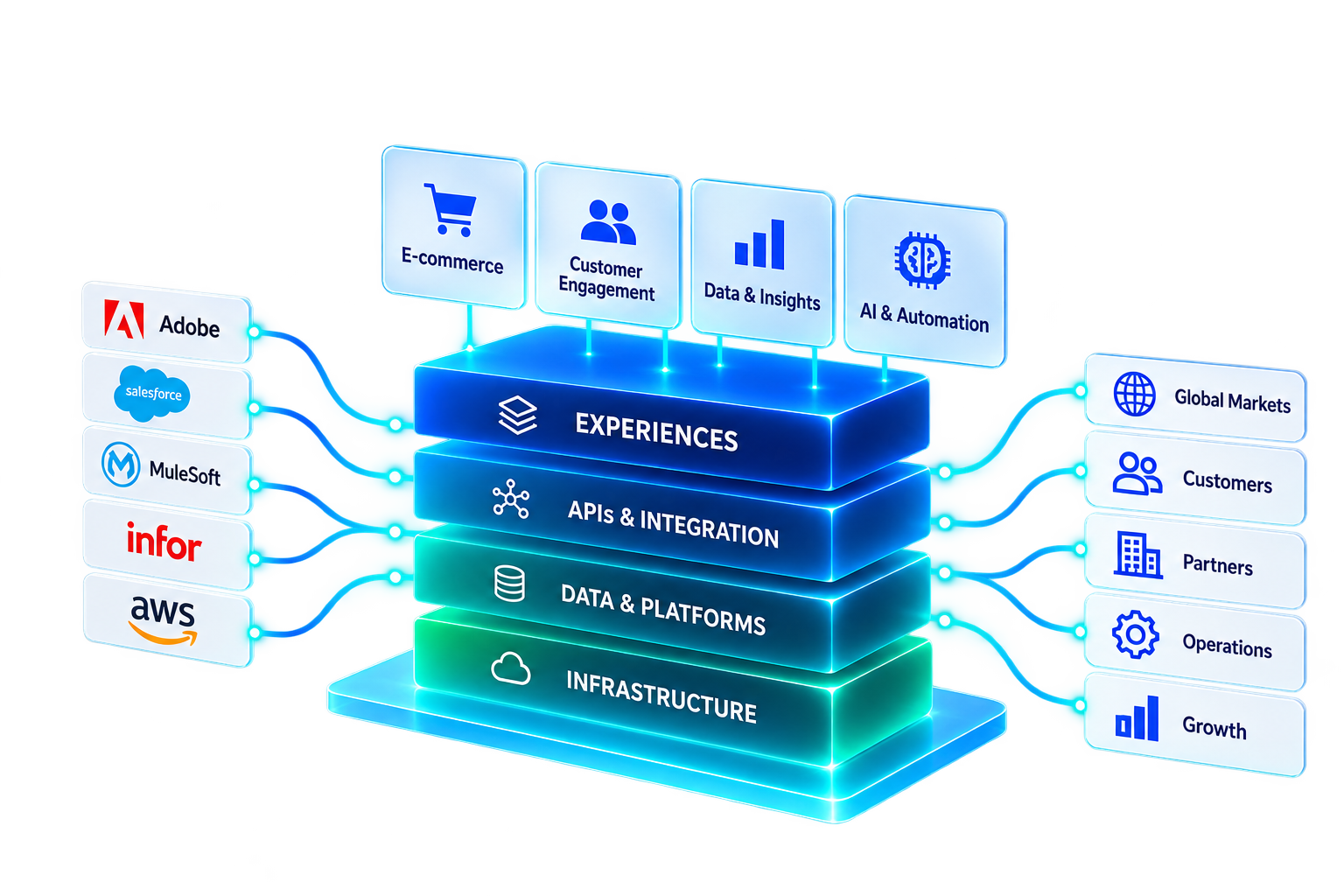
Architecture can examine, as relevant: Business capability alignment; application and platform landscape; commerce architecture; integration and APIs; data; cloud; scalability, performance and resilience; security by design; engineering and deployment; observability; maintainability and technical debt; vendor dependency; technology cost; operating model; AI readiness and extensibility.
Scope is determined by the problem and engagement. Not every engagement examines every dimension.
Capability alignment · operating model · measurable outcomes
Channels · commerce · customer and colleague journeys
Platforms · services · integration · APIs
Data access · governance · automation · extensibility
Cloud · security · resilience · engineering · observability
How we work
Architecture creates value when decisions survive contact with delivery. MC can stop after an independent assessment or continue through governance, engineering, release, stabilization and measurement.
Understand the landscape, constraints and decisions that matter.
Connect business priorities to a pragmatic direction for change.
Define the target state, principles and critical dependencies.
Turn the gap into a sequenced roadmap and actionable next steps.
Keep delivery decisions aligned with the intended architecture.
Carry decisions through engineering, release and stabilization.
Track outcomes and adapt the architecture as the business evolves.
Engagement options
A focused review for a defined concern, platform or decision.
Typically 1–2 weeks when scope is bounded.A broader assessment of the current landscape, risks, opportunities, target direction and prioritized roadmap.
Typically 3–6+ weeks depending on scope and access.A deeper cross-platform transformation definition covering target architecture, dependencies, sequencing, governance and investment decisions.
Typically 6–12+ weeks depending on complexity.Architecture leadership and governance carried into implementation so the target state becomes production capability rather than a presentation.
Ongoing senior architecture support for organizations that need independent guidance, decision governance or specialist depth over time.
A multi-capability engagement combining architecture with engineering, integration, quality, cloud and operational capabilities where MC is an appropriate delivery partner.
Durations are indicative, not fixed promises. Actual scope is agreed after discovery.
What you get
Depending on engagement scope, outputs can include:
Vendor-neutral principle
Our architecture work is vendor-neutral unless the engagement specifically requires platform or vendor evaluation. Technology choices should follow business requirements, architecture constraints and measurable outcomes—not the other way around.
Architecture + engineering
Where appropriate, MC can carry architecture decisions into commerce engineering, custom software, integration, AI, cloud, DevOps, quality engineering and managed delivery. This creates continuity between the target state, implementation decisions and operational reality.
MC sells architecture outcomes and strategic expertise—not architect hours.Relevant evidence
Our Work
Related insights
Insights
Start a conversation
Bring us the landscape, the constraint or the transformation question. We'll start by understanding the business context and determine the right level of architecture support.